









Optimal Practices for Solar Water Cleaning to Maximize Photovoltaic Efficiency

Impact of Dirty Solar Panels on Energy Output and Photovoltaic Efficiency
Dirt, dust, and mineral deposits on solar panels significantly degrade photovoltaic efficiency by physically blocking sunlight and scattering incoming irradiance. Multiple empirical studies conducted in dry climates such as the southwestern United States and southern Spain report energy production losses from soiling in the range of 5 to 25%. These losses vary by factors including geographic location, prevailing windborne particulate matter, panel tilt angle, and contaminant type.
Particulates like dust, pollen, and industrial aerosols adhere to the panel surface, forming thin layers that obstruct direct sunlight from reaching photovoltaic cells. Mineral scaling originating from hard water in cleaning operations or rainwater evaporation deposits micron-thick films of calcium carbonate or other salts, which diffuse and reduce effective solar transmittance.
Cell technology influences sensitivity to soiling. Monocrystalline silicon photovoltaic panels generally show efficiency declines up to 20% under heavy dust accumulation, higher than polycrystalline counterparts with similar soiling loads, due to differences in surface texture and cell design. Arrays mounted at low tilt angles (below 20 degrees) also retain more particulate matter, exacerbating performance losses.
Regular solar panel cleaning and maintenance are essential for preserving nominal energy yields, especially in arid regions and locations prone to industrial or agricultural dust emissions where soiling rates may exceed 0.5 grams per square meter per day.
Distinct Cleaning Methods for Solar Water Cleaning Adapted to Water Quality
Water quality is a critical parameter determining the efficacy and safety of solar panel cleaning. Optimal cleaning employs either deionized water or soft water with calcium concentration below 50 mg/L to prevent mineral residue buildup that can permanently degrade photovoltaic glass.
Cleaning methods generally fall into two categories:
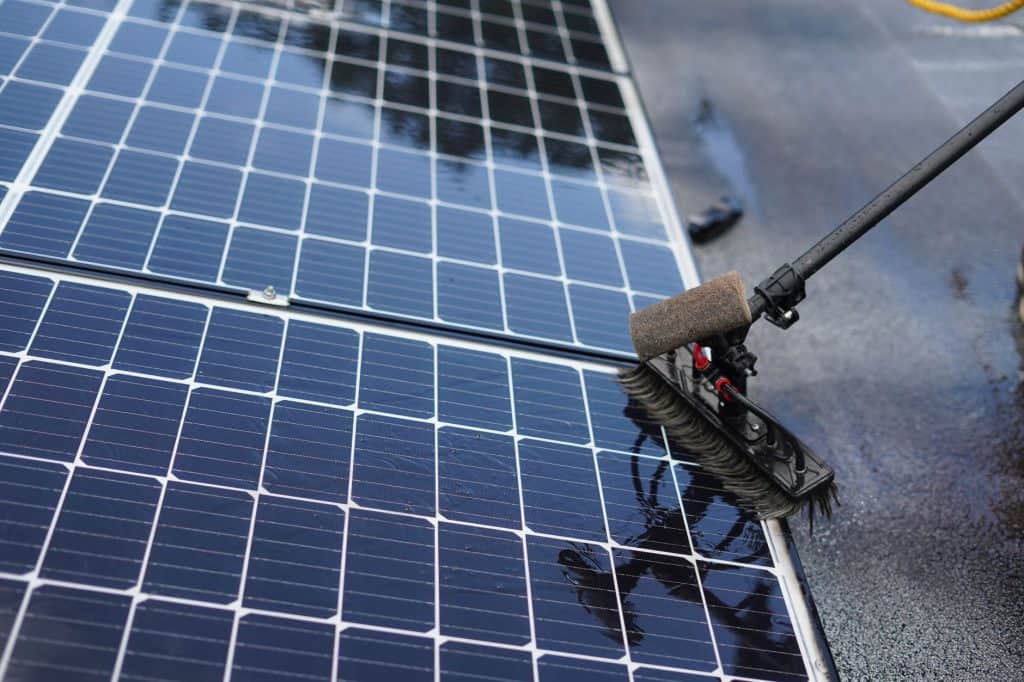
- Manual cleaning: Performed by trained technicians using soft brushes or squeegees with biodegradable detergents designed for photovoltaic surfaces. These detergents must comply with safety standards for electrical equipment, such as EN 60335-2-58, to ensure compatibility with anti-reflective coatings and to avoid chemical damage or environmental contamination.
- Automated robotic cleaning systems: Utilize programmable water jets combined with detergent dispensing and vacuuming capabilities. Such systems reduce labor costs and increase coverage consistency, particularly for large-scale installations (>100 kW). Advanced units incorporate water recycling loops to lower freshwater consumption.
Detergents applied during cleaning should have neutral pH (6.5–7.5), low conductivity (<50 μS/cm), and be free from abrasive or corrosive agents. Hard water environments require additional water treatment such as reverse osmosis prior to cleaning to avoid accelerated mineral scaling.
Recommended Cleaning Frequency and Maintenance Scheduling Based on Environmental Conditions
Establishing a cleaning and maintenance schedule depends on local climatic and environmental variables:
- In high-dust, arid environments with annual rainfall under 250 mm and particulate matter concentration above 50 μg/m³, a cleaning frequency of once every 3 months is advised to limit efficiency loss.
- Areas with annual precipitation exceeding 600 mm and regular rain events require fewer manual cleanings, with 6-month intervals typically sufficient.
Performance tracking through inverter power output and the performance ratio (PR) provides quantitative metrics to trigger cleaning when PR decreases by more than 3% relative to baseline seasonal expectations. Automated Performance Monitoring Systems (PMS) connected to SCADA or IoT platforms enhance management precision.
The Solar Plus Garden community model integrates member-supported organization of cleaning and maintenance activities, employing transparent scheduling fused with funding from solar revenues. This governance framework facilitates cost-effective routine upkeep and responsive interventions.
Safety Precautions and Compliance for Manual and Automated Solar Panel Cleaning
Strict adherence to safety precautions is mandatory to protect personnel and equipment during solar panel cleaning operations:
- Electrical safety: Panels must be de-energized and isolated using internationally recognized lockout-tagout protocols compliant with standards such as OSHA 1910.269. Verification of zero voltage before work begins is standard practice.
- Fall protection: For installations located on rooftops or elevated mounting structures, workers must use personal protective equipment fulfilling EN 363 requirements, including full-body harnesses, anchorage connectors, and guardrails.
- Chemical safety: Detergent handlers should wear gloves and eye protection per manufacturer safety data sheets (SDS). Proper storage and spill containment systems minimize environmental and personnel exposure.
Training on hazard recognition, emergency response, and equipment handling tailored for photovoltaic contexts reduces incident rates. Automated cleaning systems lessen manual intervention risks but require routine inspection and maintenance per manufacturer guidelines.
Technological Innovations in Solar Water Cleaning for Photovoltaic Systems
Innovations in technology provide enhanced efficiency and sustainability in solar panel cleaning:
- Water recycling innovations: Contemporary robotic cleaners implement closed-loop filtration systems recovering 70–90% of the water used, reducing consumption to below 2 liters per square meter cleaned. Filtration membranes remove particulates and organic contaminants.
- Anti-soiling and self-cleaning glass coatings: Advanced coatings meeting IEC 61215 performance criteria inhibit dust adhesion and facilitate natural removal by dew and rainfall, decreasing manual cleaning frequency by an estimated 30–40% under typical Mediterranean climatic conditions.
- Remote monitoring and AI-driven scheduling: Sensor arrays measure soiling accumulation and panel surface temperature. Machine learning algorithms analyze these inputs to optimize individualized cleaning cycles, minimizing operational costs without sacrificing output.
These technologies promote water conservation, lower labor requirements, and integrate well into the community-supported maintenance platforms exemplified by Solar Plus Garden.
Environmental and Cost Considerations for Solar Water Cleaning in Community Solar Projects
Community solar projects carry specific concerns balancing environmental impact and operational expenditure in solar panel cleaning:
- Water sourcing and environmental impact: Projects in urban settings often have access to municipally treated water compliant with potable and non-potable regulatory standards, minimizing contamination risks. Rural or agrivoltaic projects must implement water conservation strategies and use biodegradable detergents meeting local ecotoxicity regulations.
- Cost structure: Reported cleaning costs in European regions range from €0.50 to €1.50 per square meter per cleaning event, inclusive of labor, water, detergent, and equipment amortization. Automated robotic systems require higher initial capital expenditures but offer operational cost savings through reduced manual labor and optimized water use.
- Agrivoltaic synergy: Integration of periodic vegetation management, as in Solar Plus Garden’s community structure, helps reduce dust deposition on panels through windbreak effects and soil stabilization, indirectly lowering cleaning frequency and overall costs.
Decisions on cleaning protocols should be made after cost-benefit analysis considering expected energy yield recovery, water availability, labor costs, and community engagement benefits.
Step-by-Step Guide to Safe and Effective Manual Solar Panel Cleaning Procedures
The following procedure applies to manual cleaning of typical medium-size photovoltaic arrays (~10 kW) to ensure clean solar panels without damage:
- Preparation: De-energize the solar array. Apply lockout-tagout per OSHA 1910.269. Inspect work area for safety hazards and deploy barricades. Equip workers with PPE including gloves, safety glasses, and non-slip footwear.
- Initial rinsing: Use a soft synthetic brush and calcium-free water to gently rinse panels for 5 minutes, loosening surface dust to minimize abrasion during subsequent cleaning.
- Detergent application: Dilute a biodegradable detergent compliant with EN 60335-2-58 to manufacturer’s concentration ratio (often 0.5–1%). Apply evenly over panel surfaces using low-pressure spray systems.
- Scrubbing: Employ soft-bristled brushes for 10 minutes, concentrating on mineral scaling or sticky residues. Avoid stiff brushes or high force to prevent micro-scratches that degrade anti-reflective layers.
- Final rinse: Rinse thoroughly with soft water to remove all detergent and loose debris, preventing streaking or residue formation.
- Post-cleaning inspection: Conduct visual inspection for uniform cleanliness and inspect electrical junction boxes for moisture intrusion. Remove all cleaning equipment and verify system integrity. Restore power following established startup procedures.
FAQ
- How often should solar panels be cleaned in regions with hard water?
- In hard water regions (total hardness >200 mg/L CaCO3), mineral scaling accelerates. Cleaning every 3 to 4 months is typical, combined with use of softened or deionized water for rinsing to prevent permanent deposits that reduce photovoltaic efficiency.
- Can I use household detergents to clean my solar panels safely?
- Household detergents frequently contain surfactants, abrasives, or alkaline agents damaging to photovoltaic glass and coatings. Detergents specifically formulated for solar panel cleaning, conforming to surface safety standards such as EN 60335-2-58, should be used exclusively.
- What safety measures should be taken before starting solar panel cleaning?
- Ensure the photovoltaic system is fully de-energized and isolated per lockout-tagout procedures (OSHA 1910.269). Utilize PPE appropriate to electrical, fall, and chemical hazards. When working at elevation, apply fall arrest systems as per EN 363.
- Are automated solar panel cleaning systems cost-effective compared to manual cleaning?
- Automated cleaning systems have a higher upfront cost but reduce recurrent labor and water expenses. Their cost-effectiveness improves with installation size (>100 kW) and in regions with rapid soiling. Considerations include initial capital, frequency of cleaning, and local water costs.
Conclusion
Effective solar water cleaning integrates carefully selected cleaning methods, frequency tailored to site-specific soil and water conditions, and rigorous safety precautions. Monitoring photovoltaic performance through metrics like the performance ratio enables data-driven scheduling of cleaning and maintenance to maximize energy output.
Adoption of emerging technological solutions—robotic cleaners with water recycling, anti-soiling coatings meeting IEC 61215, and AI-based operational platforms—supports sustainable, scalable maintenance strategies. These methods align with the Solar Plus Garden community model that combines investment, operational transparency, and environmental stewardship to maintain optimal system efficiency over the long term.
Related reading
- Difference between conservative and flexible investment portfolios: A guide to optimal allocation
- Optimizing Clean Energy: How Solar Integration with CHP and BESS Enhances Reliability and Efficiency
- Understanding Organic Photovoltaics: Technology, Efficiency, and Stability for Next-Gen Solar Solutions