Preskoči na sadržaj








Solar Arc Fault Detection: AFCI Limits and Rooftop Fire Risk
An arc-fault circuit interrupter that trips on a sunny afternoon is telling you something. Either a connector on one string is degrading toward a fire, or the detection algorithm has misread inverter switching noise as an arc. Both outcomes matter, and Solar Arc Fault Detection sits at the centre of how you tell them apart — and what the protection can and cannot do once a DC arc has already started.
This article covers the mechanism of a DC arc in a PV array, the standards that govern arc-fault circuit protection, why nuisance trips happen, the installation details that decide whether AFCI helps on a rooftop, how to choose between protection options, and what an investor should ask before funding a plant. Figures appear only where they are checkable or clearly labelled as illustrations.
What a DC arc in a PV array looks like before it becomes a fire
A DC arc is a sustained electrical discharge across a gap that should not conduct. In a PV array, arcs fall into two families, and the difference determines whether the protection can see them at all.
Series arcs occur inside a single conductor path — a failed MC4 crimp, a cracked solder joint in a module junction box, a worn string DC isolator. The arc sits in series with the string, so it carries the full string current. Because the array keeps producing, nothing clears the fault: the arc persists until something physically breaks the circuit or ignites.
Parallel arcs — line-to-line or line-to-ground — draw current from the rest of the array into the fault. They can carry higher current than a series arc, but they depend on a second conductive path existing, which is why insulation damage and water ingress drive most of them.
The physics that makes series arcs dangerous is straightforward. A persistent series arc sits at roughly the array’s DC voltage — commonly 600–1,500 V on commercial strings — and dissipates tens to hundreds of watts at the fault point. That is enough energy to carbonise a connector housing, scorch a backsheet, and ignite mounting interfaces or roof membrane. The arc does not need to be large; it needs to be sustained. A junction-box solder joint that has cycled from −10 °C to 70 °C across a decade of rooftop days is a candidate long before it fails.
In the time domain, an arc leaves a signature: broadband radio-frequency noise, a rise in string current harmonics, and a voltage dip that the inverter’s maximum power point tracker reads as an irradiance change. That last point is the root of most detection difficulty — a naive threshold on voltage or current will mistake cloud transients for arcs, and mistake arcs for clouds. DC arcs also exhibit a characteristic flat-shouldered voltage waveform during the near-zero-current portion of each half-cycle, which is one of the features detection algorithms key on.
Where arcs actually start, in rough order of frequency:
- Connector mating and crimp quality at MC4 joints
- Junction-box potting failures and cracked solder joints
- UV-degraded cable insulation at roof penetrations
- Rodent damage to exposed DC cable
- Thermal cycling of screw terminals in combiners and isolators
A series arc can burn inside a closed connector housing with no external sign until the backsheet is breached. “There is no visible fault” is not evidence there is no fault — it is evidence the fault is enclosed. A thermal scan under load finds the hot joint that visual inspection misses, because a degrading connection shows as a temperature rise of several degrees above its neighbours before it shows as anything else.
Solar Arc Fault Detection inside the inverter: UL 1699B and IEC 63027 signatures
Solar Arc Fault Detection is a function of the inverter, or of a dedicated monitor in the string combiner, that continuously samples string current and voltage and runs a detection algorithm against the RF and harmonic signature of an arc. When the algorithm decides an arc is present, the device interrupts the circuit or flags the event, depending on its design.
Two standards govern this function specifically:
- UL 1699B — the standard for photovoltaic DC arc-fault circuit protection. It defines the nuisance-trip test protocols and the detection-time requirements a device must meet.
- IEC 63027 — the corresponding international requirements for DC arc detection and interruption in PV systems.
Both are worth naming precisely, because a datasheet claim of “arc-fault protection” without a standard reference is marketing, not evidence.
What a passing test buys you is a defined response, not instant disconnection. Under the test conditions in these standards, the device must detect and interrupt (or flag) an arc within seconds — not milliseconds. That delay is the reason arc-fault circuit protection reduces ignition probability rather than eliminating fire risk. An arc that persists for seconds at hundreds of watts can already have done thermal damage at the fault point.
The core engineering trade-off is detection window versus nuisance tripping. A more sensitive algorithm catches weaker arcs and trips more often on inverter switching noise. A less sensitive one stays quiet and misses slow-developing faults. Inverter firmware updates routinely shift both the sensitivity and the false-trip rate, which is why the firmware build is a practical variable in every arc event you investigate — record it alongside the event timestamp.
Terminology matters when you write a specification. The protective function is arc-fault circuit protection. The physical device may be built into the inverter, or supplied as a separate DC arc-fault detector in the string combiner. Ask which one you are buying.
Why AFCI trips on a clear day: nuisance trips from inverter noise and parallel strings
An arc fault trip on a cloudless afternoon with no load anomaly is a diagnostic problem before it is a safety problem. The common triggers are predictable:
- Inverter switching noise coupling into the DC side
- Long unshielded string runs acting as antennas for RF noise
- Parallel strings with mismatched current sharing
- Grid-side transients propagating back through the inverter into the DC circuit
Diagnose in this order, and do not skip a step:
- Read the inverter event log and firmware version. Note the timestamp, ambient temperature, and irradiance at the time of the event.
- Isolate the string. Confirm whether the trip correlates with one specific string or with a time of day and irradiance band across all strings.
- Inspect every connector in that string for crimp integrity, mating condition, and discolouration.
- Thermal-scan the array under load. A hot connector confirms the trip is genuine.
The wrong fix is also the most common one: raising the detection threshold or disabling AFCI. That stops the alarm and leaves the underlying connector or cable fault in place. A series arc carrying full string current can then develop into a fire between service visits — the protection was working, and it was switched off.
Know when the trip is genuine. A single string tripping repeatedly at the same irradiance band, a hot connector found by thermal scan, or discoloured insulation at a junction all point to a real fault. A trip that moves between strings with the weather points to noise or firmware. A useful discriminator: genuine series-arc events often cluster in the late afternoon, when connectors reach their daily thermal peak and contact resistance is highest.
Make the event diagnosable by logging the right data: per-string current, arc-fault event timestamps, firmware build, and ambient temperature at the time of the event. A monitoring platform that records only a summary alarm forces the next visit to start from zero.
Rooftop PV fires and the installation details that decide whether AFCI helps
AFCI protects the DC conductor path. It does not protect against a hot joint on the AC side, a bypass-diode failure inside a module, or a roof-penetration leak. Rooftop PV fires arise from all three, and those failure modes need different controls — which is why arc-fault circuit protection is one layer of a fire-safety programme, not the programme itself.
Rooftop installations face harsher thermal conditions than ground-mount arrays. Modules and cabling on a roof see higher ambient temperature and radiant load from the roof surface, which accelerates insulation embrittlement and the growth of contact resistance at connectors. A module backsheet can run well above ambient under full sun, and the air gap under a mounting rail traps that heat around the DC cabling. Contact resistance rises with every thermal cycle, the joint runs hotter, the connector housing degrades, and the gap that eventually arcs forms. The thermal environment is not a background detail; it is the mechanism.
Installation details that raise or lower arc probability:
- Connector crimp tooling — calibrated, with pull-test records kept
- Cable routing that keeps DC conductors off hot roof surfaces and out of standing water
- Drip loops at every roof penetration
- Mechanical protection where cable crosses sharp edges or passes through metal
- Fire-resistant separation or a defined setback between the array and roof skylights, access hatches and party walls
Commissioning evidence worth keeping, because it is the proof the detection function has something safe to detect:
- IR thermal scan of connectors and combiner under load
- Torque records for DC terminals
- String I-V curve traces
- The inverter AFCI self-test result
In reported rooftop PV incidents, DC connector and junction-box failures dominate the causes that arc-fault protection can address; module-level hot spots and AC-side faults account for the rest. That split is the honest case for AFCI and the honest limit of it. An installation that routes cable carefully but crimps it with uncalibrated pliers has done the easy half of the work.
Choosing between inverter-integrated AFCI, combiner-box detection or none
Three options, each with a real trade-off:
Option A — inverter-integrated AFCI. Most common on string inverters. Lowest incremental hardware cost, but detection lives or dies with firmware, and a nuisance trip takes the whole inverter offline.
Option B — dedicated DC arc-fault detector in the string combiner. Per-string granularity, easier to isolate a faulty string, no whole-inverter outage on a false trip. Higher hardware and wiring cost, and one more device to maintain and test.
Option C — no AFCI, relying on fuses and string overcurrent protection. Cheaper upfront, but fuses do not clear a series arc carrying normal string current. The fault persists. This is not a protection choice; it is a decision to accept the risk.
Decision inputs that actually change the answer:
- Roof type and occupancy below the array — a combustible roof over an occupied space weights the decision far more than a concrete deck
- String voltage and length
- Whether the inverter vendor publishes AFCI test evidence against a named standard
- Local code and insurer requirements (subject to change by jurisdiction)
- O&M access frequency and the cost of a truck roll
Run the comparison as total cost of protection versus the cost of one roof-level fire event, including insurance and reputational consequences — not as AFCI unit price alone. The cheapest detector is expensive if it forces a whole-inverter outage every quarter, and the most capable one is wasted if nobody reads its logs.
Worked example: nuisance-trip cost versus one avoided connector fire
The following is an illustration with stated assumptions, not a quotation. Substitute your own local labour, travel, and tariff figures.
Assumptions: a 100 kWp commercial rooftop array on 10 strings; one truck roll per nuisance trip; service visit cost of €400 per trip; 6 hours of lost generation per trip; an assumed generation value of €0.15/kWh for the lost production (tariffs and compensation schemes subject to change).
| Line item | Formula | Illustrative value |
|---|---|---|
| Truck rolls per year | trips × visit cost | 6 × €400 = €2,400 |
| Lost generation per year | trips × 6 h × 100 kW × €0.15/kWh | 6 × 6 × 100 × 0.15 = €540 |
| Total annual nuisance-trip cost | sum of the two lines | €2,940 |
| One connector fire — repair | connector, cable, labour | illustrative four-figure sum |
| One connector fire — roof repair | membrane and access | illustrative four-figure sum |
| One connector fire — downtime | days × daily generation × tariff | varies with season |
| Insurance excess | per policy | read your policy |
The crossover point is the number of nuisance trips per year at which ignoring the underlying fault becomes more expensive than fixing it. Expressed as a formula rather than a single number:
Break-even trips = (repair + roof + downtime + excess + uninsured portion) ÷ (visit cost + lost generation per trip)
Run the numbers with your own figures. In many cases the break-even sits at a handful of trips per year, which is why “the inverter keeps tripping, just raise the threshold” is a decision with a calculable cost attached — and why fixing the connector is usually cheaper than living with the alarm. The same arithmetic works against Option C: the cost of one fire, divided by the per-array cost of arc-fault protection, tells you how the decision looks before the insurance broker has to weigh in.
O&M routine that keeps AFCI trustworthy across a 25-year array life
Detection is only as good as the maintenance around it. A named, repeatable sequence:
- Annual: review inverter event logs for arc-fault events and firmware version; run the inverter’s AFCI self-test; record the result against the previous year.
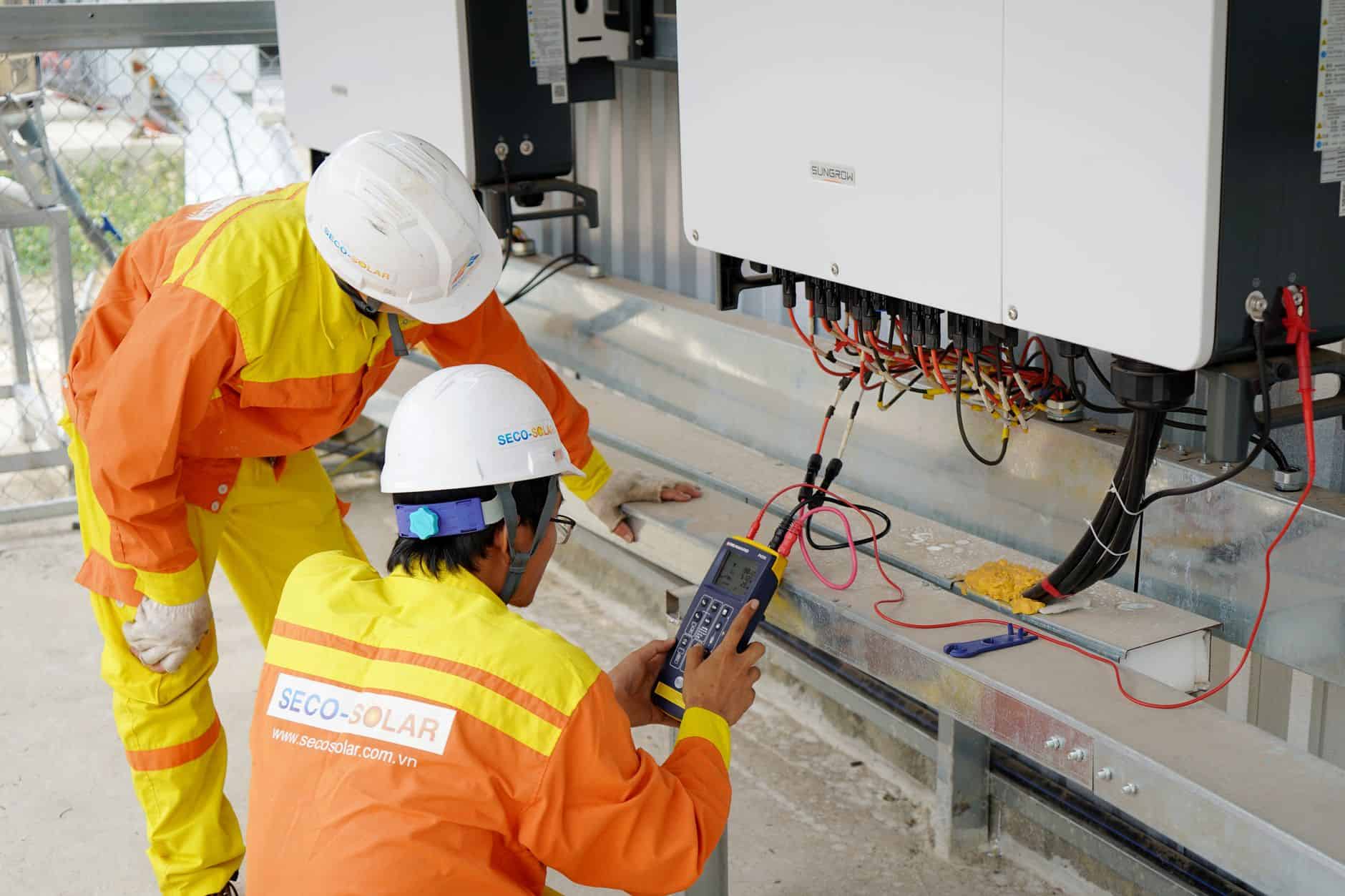
- Periodic: thermal scan of connectors, combiners and DC isolators under load. A hot connector is the leading precursor to a series arc.
- Connector audit: inspect and re-crimp any connector not installed with a calibrated crimp tool; replace rather than re-mate UV-cracked housings.
- Firmware policy: treat an inverter firmware update as a change to the protection function. Test AFCI behaviour after the update rather than assuming it is unchanged.
- Evidence pack: keep commissioning records, thermal scans, AFCI self-test logs and firmware history together. These are the proof the detection function was maintained, not just installed.
The 25-year framing is deliberate. A connector crimped correctly in year one can still embrittle under rooftop thermal cycling by year twelve. The maintenance routine exists to catch that transition before the arc does — and to leave a paper trail that supports the plant’s insurance position if a fire does occur.
What investors should ask about arc-fault protection before funding a 10 MW plant
Five questions, each tied to a piece of evidence you can demand:
- Which standard does the inverter’s AFCI claim reference, and can I see the test evidence? A datasheet line without UL 1699B or IEC 63027 named is not evidence.
- What firmware version will be deployed, and how are firmware changes controlled? The protection function is firmware-dependent.
- How are arc-fault events logged and reported to the asset owner? Per-string data retained, or only a summary alarm?
- Where is the commissioning package? Thermal scans, torque records, string I-V traces and connector crimp records — the proof the detection function has something safe to detect.
- How are nuisance trips handled contractually? Who pays for the truck roll, and what must the O&M provider do before raising a detection threshold or disabling AFCI?
For a 10 MW plant spread over many rooftops and ground-mount blocks, the answers are compounded: a single inverter model and firmware baseline simplifies O&M, but a mixed fleet means every arc event is investigated against a different firmware history. Treat arc-fault protection as part of the plant’s fire-risk and insurance position, not as a line item to value-engineer out. Code requirements and insurer conditions are subject to change by jurisdiction, so re-check them at each design review rather than relying on any article — including this one.
Često postavljana pitanja
Does my inverter’s arc fault detection stop every rooftop PV fire?
No. Solar Arc Fault Detection addresses DC series and parallel arcs on the string wiring and connectors. It does not detect a bypass-diode failure inside a module, an AC-side loose terminal, or a roof-penetration leak. UL 1699B and IEC 63027 define how the detector must respond to DC arcs under test; they do not cover those other failure modes, which is why connector quality, thermal scanning and AC-side inspection remain part of the fire-safety programme.
My inverter keeps tripping on arc fault but I cannot see any damage. Should I turn AFCI off?
No. A repeated arc-fault trip usually means a real connector or cable fault, or a firmware-related nuisance trip. Diagnose in order: check the inverter event log and firmware version, identify which string triggers the trip and at what irradiance, inspect every connector in that string, and thermal-scan the array under load. Disabling AFCI or raising the threshold leaves a series arc carrying full string current in place, which is exactly the condition that can progress to a fire between service visits.
Is arc fault protection required on a commercial rooftop system, or is it optional?
Requirements differ by country and by the applicable electrical code or insurer condition, and those rules are subject to change. Rather than assume, check the code edition your jurisdiction enforces and your insurer’s conditions for the property. If the requirement is unclear, specify inverter-integrated protection that references UL 1699B or IEC 63027 and ask the vendor for the test evidence, so the decision is documented either way.
How often should the arc fault detection function be tested after commissioning?
A practical routine is an annual review of the inverter event log and AFCI self-test result, a periodic thermal scan of connectors and combiners under load, and a fresh AFCI behaviour test after every firmware update — because a firmware change can alter both sensitivity and nuisance-trip rate. Keep the self-test logs, thermal scans and firmware history together as evidence for insurers and future buyers.
Where to start
Next step: pull the inverter event log and firmware version for the array in front of you, run the AFCI self-test, and thermal-scan the connectors and combiners under load. If the log shows repeated arc-fault events on one string, inspect and re-crimp that string’s connectors before touching any detection threshold. If you are specifying a new rooftop system, require UL 1699B or IEC 63027 evidence from the inverter vendor and write nuisance-trip responsibility into the O&M contract. What would change this answer: a jurisdiction or insurer that does not require DC arc-fault protection, or an inverter vendor that publishes test evidence and per-string event logging strong enough to make a separate combiner-box detector redundant. Code requirements, tariffs and insurer conditions are subject to change, so re-check them at each design review rather than relying on this article.