









Quantum Dot Solar Cells: Engineering High-Efficiency Photovoltaics with Nanocrystal Technology
Fundamental Principles of Quantum Dot Solar Cells and Photovoltaic Conversion
Quantum dot solar cells are a specialized category of solar cells that utilize semiconductor nanocrystals called quantum dots to convert sunlight into electrical energy. Unlike traditional solar cells which use bulk materials like crystalline silicon with fixed bandgaps (typically 1.1 eV), quantum dot solar cells leverage the principles of quantum dot solar operation based on quantum confinement effects that modulate electronic and optical properties at the nanoscale.
Fotowoltaika conversion in quantum dot solar cells follows the fundamental solar cell mechanism where incident photons generate electron-hole pairs (excitons). However, quantum dots offer size-dependent bandgap tunability, typically ranging from about 1.0 to 2.5 eV for dots sized 2 to 10 nanometers. This tunability allows tailored absorption profiles optimized for the solar spectrum’s visible to near-infrared (NIR) range (approximately 400 to 1000 nm wavelength). The size-adjustable bandgap enables absorption of photons across distinct energy ranges, enhancing spectral capture beyond the limitation of fixed-bandgap materials.
This spectral adaptability is achieved by controlling the quantum dot size distribution during synthesis, enabling a tailored overlap with standard terrestrial solar spectral irradiance AM1.5G. This optimization has a direct influence on achievable efektywność, as it lowers thermalization losses from high-energy photons and extends harvesting into lower-energy wavelengths. Therefore, quantum dot solar cells harness multiple physical phenomena inherent in nanocrystals to improve charge carrier generation and transport efficiency compared to single-junction conventional solar cells.
Synthesis and Integration Techniques for Quantum Dots in Solar Panel Fabrication
The manufacturing of quantum dot solar cells requires precise control over nanocrystal synthesis and deposition to achieve uniform active layers with minimal defects, crucial for high efficiency quantum dot device performance.
The primary method of quantum dot production is colloidal synthesis, which involves controlled nucleation and growth reactions in solution. Process parameters such as reaction temperature (typically 150–300 °C), precursor molar ratios, and ligand chemistry determine dot size uniformity, shape, and surface passivation quality. For example, lead sulfide (PbS) quantum dots synthesized via hot-injection methods exhibit size distributions under 10% coefficient of variation, critical for consistent bandgap properties.
After synthesis, quantum dots are deposited onto substrates using specialized thin-film coating techniques:
- Spin coating: A solution of quantum dots suspended in a volatile organic solvent is dispensed onto a rotating substrate (usually glass or flexible polymer) at 1000–3000 rpm, producing films around 100–300 nm thick with uniform coverage.
- Layer-by-layer assembly: Alternating depositions of quantum dots and ligands enable films with engineered thickness up to 1 µm and controlled interfacial properties to optimize charge transfer.
- Chemical vapor deposition (CVD): Emerging CVD methods adapt for quantum dot formation directly on substrates, though this is less mature and primarily under research development for achieving epitaxial-quality layers.
Device architectures increasingly use quantum dots either as standalone absorber layers in thin-film cells or as spectral tuning components in tandem assemblies combined with perovskites or silicon. These hybrid designs exploit the high efficiency potential of quantum dots for extended spectral response while leveraging robust charge transport properties of established photovoltaic materials.
Mechanisms Enhancing Efficiency in High-Efficiency Quantum Dot Solar Cells
Several distinct mechanisms contribute to the elevated efektywność potential of high efficiency quantum dot solar cells beyond conventional photovoltaic limits:
- Multiple exciton generation (MEG): Quantum dots can produce two or more electron-hole pairs per absorbed photon when the photon energy exceeds twice the bandgap. Experimental measurements on PbSe and PbS quantum dots have shown MEG quantum yields up to 1.7–2.0 under photon energies greater than two times the bandgap, enhancing photocurrent density substantially.
- Hot-carrier extraction: Quantum confinement slows carrier thermalization. Hot carriers in quantum dots retain excess kinetic energy longer (on the order of hundreds of femtoseconds) compared to bulk materials (tens of femtoseconds), allowing extraction before energy loss as heat, improving open-circuit voltage and overall power conversion efficiency.
- Size distribution engineering and surface passivation: Synthesis with tight size distributions (less than 10% variance) ensures uniform bandgap and minimal spectral broadening. Passivating surface trap states with ligands like oleic acid or thiol groups mitigates non-radiative recombination, improving charge carrier lifetime, which typically ranges between 10–100 nanoseconds under operating conditions.
These mechanisms collectively enable quantum dot solar cells to theoretically surpass single-junction Shockley-Queisser limits (~33% for silicon) by effectively increasing photocurrent and voltage outputs through enhanced exciton management.
Material and Device Stability Challenges for Quantum Dot Photovoltaics in Commercial Solar Panels
Despite promising high efficiency quantum dot characteristics, material and device stability remain critical bottlenecks for commercial deployment.
Quantum dots are susceptible to degradation through:
- Oxidation: Ambient oxygen exposure reacts with reactive surface sites, especially in chalcogenide quantum dots (e.g., PbS, CdSe), leading to altered surface stoichiometry and increased trap densities.
- Wnikanie wilgoci: Water penetration causes ligand displacement, chemical dissolution, and structural changes in the quantum dot film, accelerating performance decay.
- Ultraviolet (UV) exposure: Continuous UV illumination induces photochemical degradation of organic ligands and quantum dot cores, evident in accelerated decay under ISOS-D-1 accelerated aging protocols.
Current quantum dot solar cells demonstrate operational half-lives of less than 3 years under standard testing, far below the 20–25 years target for silicon panels specified in IEC 61215 durability standards. Encapsulation strategies combining multilayer polymer barrier films with hermetic sealing have shown improvements, extending device stability to over 1000 hours of damp heat testing (85 °C / 85% relative humidity), a benchmark toward commercial viability.
Achieving compatibility with IEC 61730 safety and environmental hazard criteria is ongoing, requiring non-toxic substitute materials (e.g., indium phosphide-based quantum dots) to replace lead-based compositions in future commercial modules.
Performance Benchmarks: Comparing Quantum Dot Solar Cells with Conventional Photovoltaic Technologies
Quantum dot solar cells currently demonstrate competitive laboratory-scale metrics but face scaling and commercial challenges versus established photovoltaics:
- Power conversion efficiency (PCE): Record certified PCEs for quantum dot solar cells reach approximately 15% on small-area devices (~1 cm²). By comparison, commercial monocrystalline silicon panels deliver 20% to 23% under standard test conditions (STC), while perovskite solar cells demonstrate lab efficiencies exceeding 25%.
- Manufacturing scalability: Silicon PV leverages decades of industrial refinement with automated production lines yielding consistent quality and costs around $20–30 per MWh (subject to regional variation). Quantum dot cell fabrication remains chiefly in R&D and pilot-scale fabrication, with challenges in uniform quantum dot film deposition over module-sized areas impacting yield and reproducibility.
- Spectrum management advantages: Quantum dots enable multi-junction cells with layer-specific bandgaps between approximately 1.0 and 2.5 eV, theoretically increasing overall device efficiency via tandem architectures. These cells also support flexible and semi-transparent form factors with modulated light transmission ranging from 20% to 60%, opening niche applications like window-integrated photovoltaics or agrivoltaics.
Integration Potential of Quantum Dot Solar Cells in Agrivoltaic and Community Solar Projects
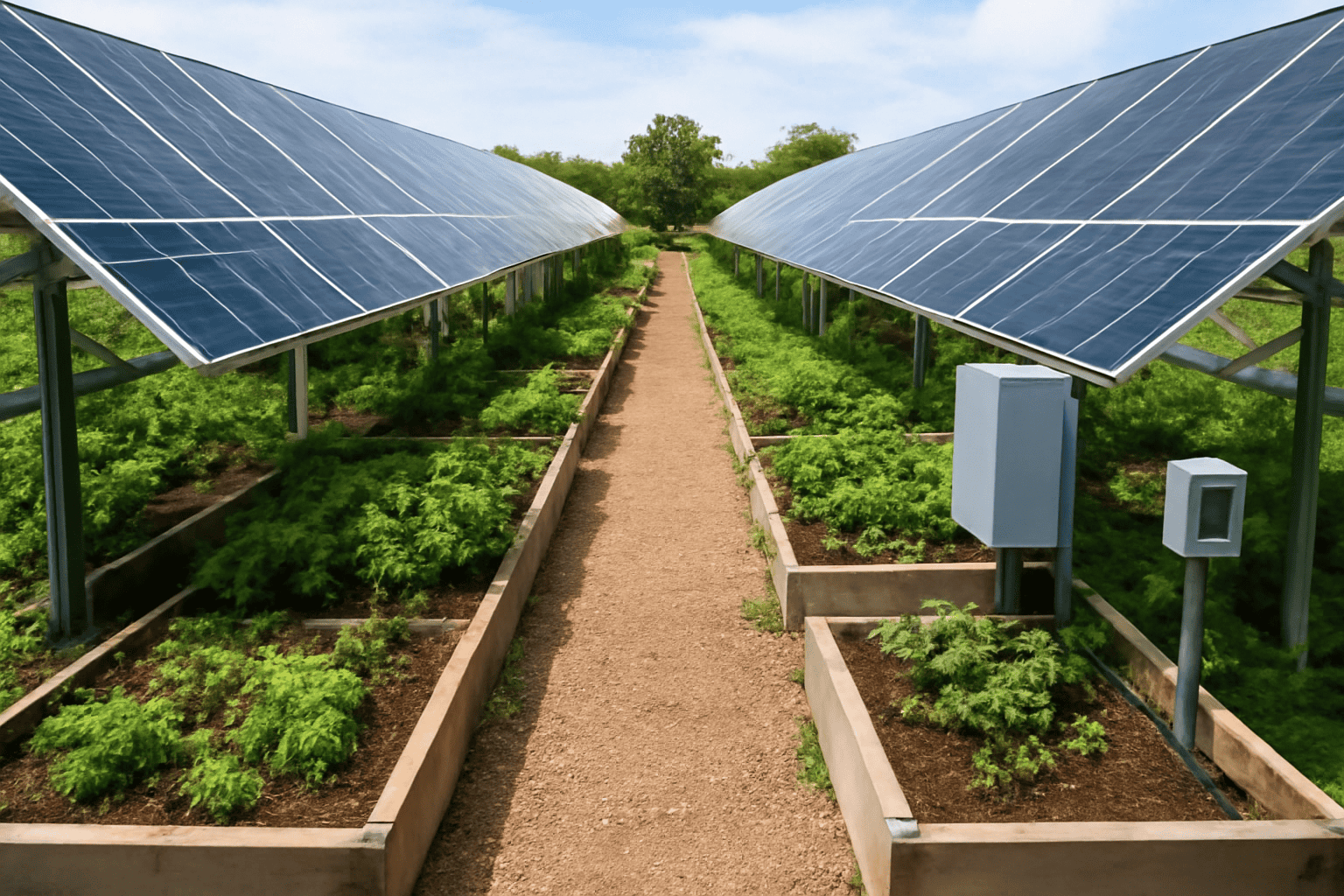
The adaptability of quantum dot solar cells aligns with agrivoltaic and community solar initiatives, including platforms such as Solar Plus Garden:
- Partial transparency for crop optimization: Quantum dot modules designed with controlled bandgap distributions permit light transmission optimized for photosynthetically active radiation (PAR), allowing 20–60% sunlight penetration suitable for various agricultural crops.
- Modular scalability and investor alignment: Small to medium quantum dot solar arrays fit modular investment models enabling fractional ownership, consistent with Solar Plus Garden’s community membership framework where membership fees finance solar investment and local agrarian activities.
- Land use synergy: Co-deployment of solar cells and garden/agriculture on the same land parcel results in combined energy and food production. This synergy increases land productivity metrics (kWh/m² and kg produce/m²) and supports regenerative local economies with minimal trade-offs.
Regulatory and Certification Landscape Affecting Quantum Dot Solar Cell Deployment in Europe
The regulatory framework for quantum dot solar cells in Europe requires compliance with and adaptation of existing photovoltaic standards, with ongoing updates targeting nano-enabled devices:
- Ten IEC 61215 standard for design qualification and type approval is applied to assess mechanical, electrical, and environmental durability. Quantum dot devices undergo accelerated damp heat (85 °C/85% RH), thermal cycling (-40 °C to +85 °C), and UV exposure tests to validate robustness.
- IEC 61730 governs safety testing including potential-induced degradation and fire resistance. Upcoming revisions anticipate specific clauses addressing quantum dot materials’ chemical stability and toxicity risks.
- Ten EU Renewable Energy Directive (RED II) includes requirements for sustainability reporting, life-cycle assessment, and environmental criteria influencing qualification for renewable energy incentives and investment eligibility.
Industry consensus projects that by 2027 new certification annexes specifically addressing quantum dot photovoltaics and nano-material risk profiles will be formalized, requiring early engagement with certification bodies for developers planning commercial deployment.
Często zadawane pytania
- What distinguishes quantum dot solar cells from traditional silicon solar cells in terms of efficiency?
- Quantum dot solar cells employ size-tunable nanocrystals that extend absorption into near-infrared wavelengths and support multiple exciton generation, theoretically enabling photocurrents and voltages beyond silicon cells with fixed bandgaps, contributing to potentially higher efektywność.
- Are quantum dot solar cells currently commercially available for investments and inclusion in community solar projects?
- As of 2026, quantum dot solar cells remain at the pilot and early commercial prototype stage. Their full integration into investment platforms like Solar Plus Garden depends on further technology maturation, scalability demonstration, and regulatory certification compliance.
- What are the main challenges affecting the long-term stability of quantum dot photovoltaic panels?
- Quantum dot layers degrade primarily due to moisture, oxygen, and ultraviolet exposure, causing chemical and structural damage that limits operational lifetime relative to silicon panels. Advanced encapsulation and ligand chemistry optimization are central to improving stability.
- How can quantum dot solar technology enhance agrivoltaic projects managed under członkostwo w społeczności models?
- Quantum dot modules engineered for partial transparency and tailored spectral output allow sufficient sunlight for crop photosynthesis alongside clean energy generation, fitting the combined agrivoltaic and community-driven investment models such as those implemented by Solar Plus Garden.
Wniosek
Quantum dot solar cells utilize nanocrystal properties to achieve customizable spectral absorption and advanced exciton dynamics, providing avenues for high efficiency quantum dot photovoltaics. Ongoing progress in synthesis control, device architecture, and encapsulation technologies is essential to overcome current stability limitations. For investors and project developers involved in integrated solar plus garden community schemes, tracking certification advancements and pilot-scale operational data will inform timing and risk assessment for commercial quantum dot solar deployments. Practical adoption will depend on demonstrating long-term durability and economic viability at scale relative to conventional photovoltaic technologies.