Passer au contenu





Solar Supply Chain Analysis: What a 10 MW Buyer Faces in 2026–27
A 10 MW plant is a mid-size order in a market built around gigawatt tenders. That single fact shapes almost every problem a buyer encounters in this solar supply chain analysis: too small to command a top-tier factory’s direct sales attention, too large to buy off a shelf, and long-lived enough that today’s sourcing decision determines whether you can replace a failed module in 2039. What follows traces the chain from quartz to grid connection, prices the stack, and sets out the contract levers that move risk.
Crystalline Silicon PV Supply Chain: The Nine Steps From Quartz to Grid Connection
The mainstream solar supply chain runs through nine distinct stages. Each has different capital intensity, different concentration, and different lead times.
- Quartz and metallurgical silicon. Quartzite is reduced with carbon at high temperature to metallurgical-grade silicon, roughly 98–99% pure.
- Polysilicon. Purified to electronic or solar grade, usually by the Siemens process (trichlorosilane deposition in a bell-jar reactor) or the fluidised bed reactor (FBR) route, which uses less energy per kilogram.
- Ingot casting. Polysilicon is melted and crystallised into monocrystalline ingots (Czochralski pulling) or multicrystalline blocks.
- Wafer slicing. Ingots are wire-sawn into wafers, typically 182 mm or 210 mm format in current production.
- Cell processing. Doping, passivation and metallisation turn a wafer into a cell — TOPCon has become the dominant commercial architecture, with heterojunction (HJT) and back-contact variants holding smaller shares.
- Module assembly. Cells are strung, laminated between encapsulant and glass, and framed.
- Junction box, frame and connectors. Often sourced from separate suppliers rather than made in-house.
- Inverter and balance of system (BOS). String or central inverters, mounting structures, DC cabling, combiners, transformers.
- EPC and grid connection. Civil works, installation, commissioning, and the utility’s connection agreement.
The hand-offs matter. Wafer-to-cell and cell-to-module are the two most common points where one company’s output becomes another’s input, which means the “manufacturer” on your purchase order may have bought the cells. Vertically integrated producers run polysilicon through module under one roof; most do not.
Capital intensity explains the concentration. A module assembly line is the least capital-intensive link in the chain and therefore the most contestable — dozens of operators can and do run one. Polysilicon and wafer fabrication are the most capital-intensive and the most concentrated in a small number of firms. When people talk about supply-chain risk in panneaux solaires, they are usually describing a bottleneck three or four steps upstream of the factory that will ship their order.
A 10 MW order sits below the minimum run rate that top-tier Chinese producers’ direct sales teams will service. In practice the buyer contracts through a distributor, a regional integrator, or a developer aggregating several projects. That intermediary layer adds a margin but also adds something valuable: in-region stock and a counterparty who already holds the certifications.
End-to-end lead time for tiers not held in regional stock typically runs 12–24 weeks from purchase order to delivery at site. Inverters can exceed that during grid-code certification bottlenecks, because a model not yet registered in the destination market cannot be energised regardless of when it arrives.
Where the Global Solar PV Supply Chain Is Concentrated — and Why That Matters for Delivery Risk
Polysilicon, wafers, cells and modules are dominated by producers in China. Secondary cell and module capacity sits in Southeast Asia — Vietnam, Malaysia, Thailand, and more recently Laos and Indonesia. That geography is not incidental to price; it is the map on which trade policy is drawn.
Trade measures change delivered cost by redirecting sourcing rather than eliminating it. When a duty raises the cost of one origin, capacity migrates to another origin and the documentary trail becomes the battleground. The instruments a buyer should be able to name:
- EU anti-dumping and countervailing duty regimes on solar products, plus the Foreign Subsidies Regulation (FSR), which can affect companies bidding into public procurement and mergers.
- US anti-dumping and countervailing duty (AD/CVD) cases covering cells and modules from Southeast Asian origins, which have repeatedly reshaped where capacity is sited.
- Customs classification — cells versus modules, and the origin of the cell rather than the assembly location, frequently determine the rate.
The EU has no blanket tariff on Chinese modules, but it does operate trade-defence instruments and the FSR. Every one of these is subject to change through 2027; no rate or expiry date should be treated as stable enough to build a financial model on without re-verification at contracting.
For a 10 MW project the practical consequence is that tier, country of cell origin, and the documentary trail — origin certificates, bills of lading, mill certificates — determine both duty exposure and bankability. These are contractual terms, not paperwork to sort out at the port. A lender that cannot trace the origin of the cells will not accept the module supply as bankable, whatever the price.
Module Price Stack: What Actually Drives €/Wp, and Why Quoted Prices Are Not Comparable
A module price is a stack of cost components, and the components do not move together. Polysilicon and wafer swings have historically driven most of the volatility; glass, encapsulant and freight move on their own cycles; labour and overhead are relatively stable.
Illustration only — percentage cost stack for a c-Si module. These shares are indicative of the structure of module cost, not a quote, and absolute €/Wp moves month to month.
| Cost component | Approximate share of module cost (illustrative) | Volatility driver |
|---|---|---|
| Polysilicon | Roughly one-fifth to one-third | Capacity additions, energy prices at production sites |
| Wafer | Roughly one-tenth to one-fifth | Ingot and slicing capacity, wafer thickness trends |
| Cell processing | Roughly one-tenth to one-fifth | Metallisation pastes, efficiency upgrades |
| Verre | Single-digit to low double-digit | Float glass capacity, solar-glass allocation |
| Encapsulant (EVA/POE) | Low single digit | Resin prices |
| Frame and junction box | Single digit each | Aluminium, copper |
| Labour and overhead | Single digit to low double-digit | Factory utilisation |
| Freight | Varies widely by lane and season | Container rates, route disruption |
| Margin | Varies by tier and order size | Competitive intensity, order book |
Because the absolute number moves, the buyer’s discipline is to compare like with like on the delivered basis. Three price conventions are routinely quoted and rarely distinguished:
- FOB factory — the seller’s obligation ends when goods are loaded at the named port of shipment. Freight, insurance and import clearance are yours.
- CIF port — cost, insurance and freight to a named destination port. The seller pays to get it there; risk transfers on shipment, and inland haulage is still yours.
- DDP delivered to site — the seller carries the goods, clears import and delivers to the project gate. Highest headline number, lowest number of surprises.
A 10 MW order is roughly 18,000–20,000 modules at 550 Wp, or fewer at higher wattage classes (around 15,000–16,500 at 620 Wp). That is a small number of containers relative to utility-scale, which makes the order less attractive to top-tier logistics desks and more likely to be consolidated with other cargo.
Quotes with different Incoterms, warranty terms and tier classifications are not comparable line for line. A CIF quote from a Tier-2 supplier is not “cheaper” than a DDP quote from a Tier-1 supplier — it is a different product with different risk attached.
Tier-1, Tier-2 and Bankability: How Lenders Read a Supplier List
“Tier-1” is a BloombergNEF classification. It is awarded to manufacturers that have supplied own-brand, own-manufactured modules to a defined minimum number of projects above a size threshold in the prior two years (currently six projects). It is a bankability signal, not a quality guarantee — the classification says nothing about a specific factory’s process control on the day your order runs.
What banks and investors actually apply is a longer list:
- Audited financials and a parent company with assets that can back a warranty claim.
- CEI 61215 for module design qualification and type approval, and CEI 61730 for module safety qualification.
- IEC 61701 for salt-mist corrosion resistance, relevant where the site has coastal or de-icing-salt exposure.
- IEC 60068 environmental testing series, used for robustness testing of components including junction boxes and connectors.
- Factory audit — either the buyer’s own or a third-party production audit at the named factory, not the trading company’s office.
- Warranty backed by a parent guarantee, not just the selling entity’s balance sheet.
Warranty structure deserves its own paragraph because it is where buyers get surprised. Two warranties usually apply: a product warranty covering manufacturing defects (commonly 12–15 years) and a performance warranty covering power output, expressed as a maximum annual degradation rate and a guaranteed terminal percentage at year 25 or 30. The critical question is who pays if the manufacturer is insolvent at year 12 — a parent guarantee, an insurance-backed warranty, or a bank guarantee in escrow are the three practical answers.
Solar Plus Garden’s own pre-incorporation phase and the project’s stated red line — no structure the team does not fully understand — argue for conservative supplier selection over cheapest-per-watt selection. For a community-funded plant, a warranty counterparty that vanishes is a community liability.
A pass/fail checklist to hand a procurement lead:
- Is the manufacturing factory named, with an audit report less than two years old?
- Are IEC 61215 and IEC 61730 certificates held for the exact model and wattage class being ordered?
- Is the product warranty backed by a parent or bank guarantee with a written claims process?
- Is the cell origin documented, and does it match the duty position assumed in the financial model?
- Is the performance warranty expressed as both an annual degradation cap and a terminal year figure?
- Has the financier accepted the tier and the warranty counterparty in writing?
Any “no” is a stop, not a negotiating position.
Logistics for a 10 MW Order: Port Choice, Container Math and Landed-Cost Traps
A 40-foot high-cube container holds roughly 600–700 modules depending on wattage and packing density. At 10 MW, that is on the order of 30 containers of modules plus BOS — enough to justify a single consolidated shipment and one customs broker, and small enough to be consolidated with other cargo if freight rates spike.
Two realistic routes for a Serbia-bound project:
- China → Piraeus → rail/truck to Serbia. Frequently the shorter and cheaper inland leg into the Balkans, with good rail connectivity from the Greek port.
- China → Koper or Rijeka → truck to Serbia. Adriatic ports closer to the destination; road haulage dominates the inland leg.
For an EU-domiciled buyer — an Estonian OÜ, for example — the routing differs: China → Rotterdam or Hamburg → inland, with EU import clearance and EU VAT treatment at the point of entry.
Landed-cost items routinely missed in a first quote:
- Import VAT treatment and cash-flow timing (recoverable or not depends on the buyer’s registration and jurisdiction).
- Customs classification of modules versus cells.
- Port storage and demurrage before clearance.
- Inland haulage, including any oversized or heavy-load permits.
- Unloading equipment and labour at site.
- Marine cargo insurance to full replacement value, not declared value.
Physical handling constrains the schedule as much as the price. Modules ship vertically in crates, cannot be double-stacked, and need hardstand storage. A 10 MW delivery requires staged unloading across multiple days, not a single drop at the gate — and a site that cannot absorb 30 containers of vertically crated glass on the day they arrive will pay for the truck to wait.
Customs and VAT treatment are both subject to change and jurisdiction-specific. Confirm with a broker at contracting, and fix the origin documentation as a contract annex.
Single-Source vs. Dual-Source: An Illustrated Supply Strategy Comparison for a 10 MW Plant
This table is an illustration, not a market statistic. Assumptions: identical tier, identical warranty length, same delivery window, same wattage class — so the comparison isolates sourcing strategy, not product.
| Facteur | Single supplier | Dual supplier (70/30 split) | Distributor + factory |
|---|---|---|---|
| Price | Lowest unit cost (volume leverage) | Slightly higher; two sets of freight and fees | Distributor margin, but regional stock may offset freight |
| Lead-time certainty | One schedule to track; one failure point | Roughly halves exposure to a single factory outage | Fastest if stock exists; slower if it does not |
| Warranty administration | One counterparty, one claims process | Two counterparties, two claims processes | Distributor may not hold the warranty obligation |
| Spare-parts availability | Model may be discontinued by the single factory | Two model families to stock — higher reserve cost | Stock held locally; best short-term, unclear long-term |
| Bankability documentation | Cleanest single trail | Two certification sets, two origin trails | Strongest on delivery, weakest on counterparty depth |
Dual-sourcing roughly halves exposure to a single factory’s outage, but adds a second set of certifications, a second warranty counterparty, and a second spare-module stock. For a plant running 25+ years, that second stock is real money — and a second model family may itself be discontinued sooner than a single chosen model would have been.
The spare-parts reality deserves its own line. A 10 MW plant needs a reserve of the exact module model for replacements, and that exact model may be discontinued within a few years of commissioning. The sourcing decision therefore determines long-term replaceability. The contract should state who bears the cost of a replacement model that does not match the installed one.
Agrivoltaics and Garden-Scale Procurement: Why a Small Parcel Changes the Supply Chain
Elevated or spaced agrivoltaic arrays change the mounting and module choice in ways that reduce the pool of standard stocked SKUs:
- Higher clearance for machinery and crops, which drives taller racking with different structural loading.
- Bifacial modules to exploit ground albedo, which changes the module bill of materials and often the tracker or racking design.
- Possibly narrower module formats where row spacing and light transmission are constrained.
For Solar Plus Garden, the connection is direct: Garden membership fees are invested in solar, and revenue from the plant funds community activity. Supply-chain choices therefore have a community-cost consequence — a procurement decision that adds a percentage point to the delivered €/Wp is not an abstraction, it is a cost borne by the model that funds the Garden.
Agrivoltaïque has no single certification. The relevant engineering references are the mounting structure’s structural design codes and the module’s IEC certifications; there is no special “agrivoltaic standard” to cite.
The critical-path observation is the useful one: dual-use arrays often need custom racking with longer lead times than standard ground-mount, so the critical path for agrivoltaic supply is the racking, not the module. Buyers who treat the module as the long-lead item and the racking as a commodity routinely discover the reverse two months before construction.
Contract Clauses That Move Supply-Chain Risk: A Sequenced Checklist Before You Sign
Six clauses, in the order they should be settled:
- Fix the bill of materials as an annex, not a line in the body. Module model, wattage class, cell origin, inverter model and firmware revision. Anything in the body text is negotiable in practice; an annex is harder to move.
- Define delivery terms with Incoterms and a named place, a delivery window, and liquidated damages. Calculate liquidated damages on lost generation, not on order value — otherwise the penalty is trivial relative to the cost of a delayed commissioning.
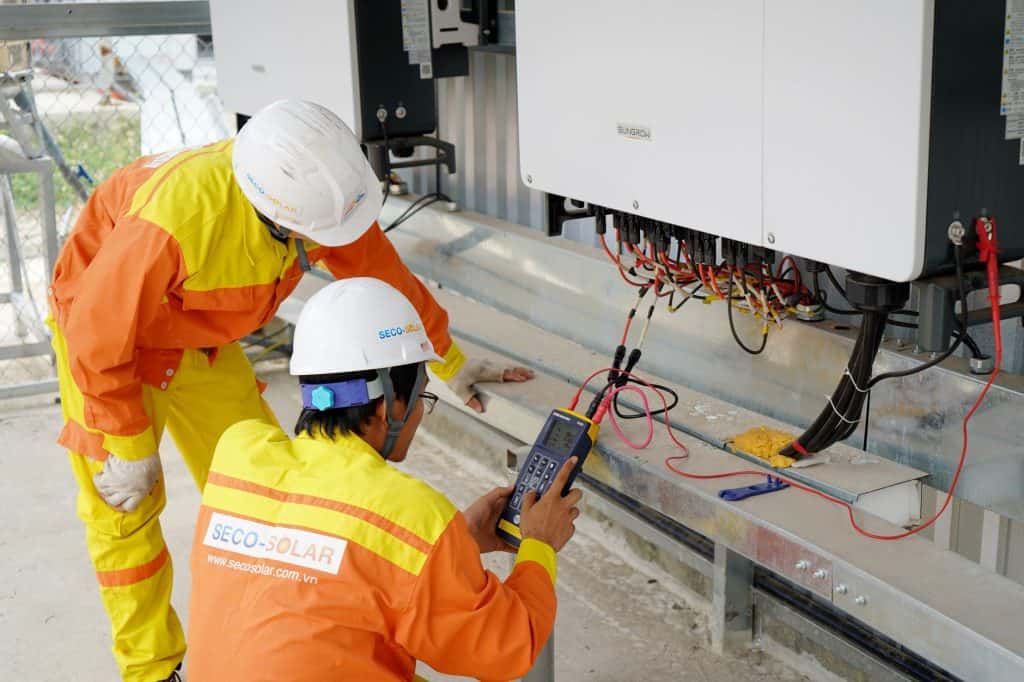
- Require pre-shipment inspection and factory acceptance testing, with the right to a third-party inspector at the factory. Name the inspector or the category of inspector, and make the right exercisable on short notice.
- Secure a performance guarantee backed by a parent company or bank guarantee, plus a defined warranty claims process with a stated response time. A response time is a clause; “reasonable endeavours” is not.
- Write the change-order mechanism for force majeure, trade-measure changes and component substitution. Substitution requires written approval and equivalence evidence — a test report, not a datasheet.
- Retain a percentage of payment until commissioning and grid connection, with the exact release trigger written down rather than implied. “Successful commissioning” needs a definition and a named issuer of the certificate.
What Could Break the 2026–2027 Solar Supply Chain — and What the Reader Should Watch
Four observable signals, not forecasts:
- Trade-measure changes in the EU and US — new AD/CVD scope, FSR proceedings, and any change to origin rules.
- Polysilicon capacity announcements — additions or closures that shift the upstream price and, eventually, module pricing.
- Inverter grid-code certification backlogs — the register of approved models in the destination market, and how long a new model takes to enter it.
- Freight-rate indices on the relevant lane — China–Mediterranean and China–North Europe container rates, which feed directly into landed cost.
Distinguish short-term price volatility (polysilicon, freight) from structural delivery risk (cell and wafer concentration, certification queues). The first can be hedged with a fixed-price offer valid for a stated period. The second cannot — it can only be contracted around.
The reader should not forecast prices but should forecast lead times, because lead times are what break construction schedules and financing milestones. A 20% price move is a budget variance; a 12-week delay is a missed commissioning date and, often, a missed financing condition.
The buyer-side hedge is to contract before policy changes rather than after, and to fix the BOM so that a substitution request is a negotiation rather than a fait accompli. Every policy item in this section is subject to change through 2027.
FAQ
How long does it realistically take to source and deliver solar panels for a 10 MW project in 2026?
Plan for 12–24 weeks from purchase order to delivery at site for modules, plus additional weeks for inverter grid-code certification if the inverter model is outside the local certification register. Projects that rely on regional stock can compress this, but stock of the exact wattage and model needed should be verified, not assumed. Add port clearance and inland haulage on top.
Should I buy Tier-1 modules for a 10 MW plant, or is Tier-2 acceptable?
Tier-1 is a bankability signal that helps lenders and investors accept the delivery schedule and warranty. For a plant that will be financed or offered to small investors, Tier-1 plus a parent-company guarantee is the safer default. Tier-2 can be acceptable if the buyer accepts the warranty counterparty risk and if the financier does in fact accept it — confirmed in writing before ordering, not after.
Do trade tariffs and anti-dumping duties change what I pay for modules delivered to Serbia or the EU?
They can. Origin of the cell, not just assembly, often determines duty treatment, and EU and US trade measures have shifted sourcing between China and Southeast Asia. Serbia’s customs treatment differs from an EU member state’s. Rates and scope are subject to change, so confirm the current position at contracting with a customs broker and fix the origin documentation as a contract annex.
How many spare modules should a 10 MW plant hold for supply-chain reasons?
There is no single rule; the practical figure is driven by the O&M contract and the likelihood that the exact model will remain purchasable. The supply-chain point is that the sourcing decision should include a reserve of the identical model, and the contract should state who bears the cost if the manufacturer discontinues it before the plant’s operating life ends.
Before You Sign
Fix the bill of materials and the origin documentation as contract annexes. Obtain written confirmation from your financier that the chosen tier and warranty counterparty are acceptable. Price the delivered landed cost with named Incoterms rather than comparing FOB quotes against DDP quotes and calling the difference a saving.
The answer changes if trade measures in the EU or US materially shift in 2026–2027, if the chosen inverter falls out of the local grid-code certification register, or if the manufacturer discontinues the exact module model. In any of those cases, re-run the sourcing comparison rather than renegotiating a single clause — because each of those events changes the counterparty, the documentation trail and the reserve stock position at the same time.