Preskoči na sadržaj









Augmented Reality Solar Maintenance: Where AR Earns Its Cost
Augmented Reality Solar Maintenance is not a display technology problem. It is an information logistics problem that happens to be delivered through a lens. The technician standing at string 14 of a 10 MW array in July does not need prettier graphics — they need to know, without walking back to the truck, which combiner feeds this row, which module serial sits under that crack, and when the string last produced nameplate output. AR earns its cost when it removes that lookup step. It loses its cost when it decorates a repair the technician already knew how to do.
What Augmented Reality Actually Changes on a Solar Panel Maintenance Site
The definition matters because the market blurs it. Real AR registers digital geometry onto the physical world — a head-mounted or tablet overlay that locks a panel outline, string label or torque value onto the actual racking to within centimetres. A 3D model of the plant rotating on a laptop screen is not AR. It has no spatial registration, so it cannot tell the technician which of two adjacent modules is the one flagged in the fault log.
Two task families do real work in solar panel maintenance:
- Survey and as-built overlay. Used during installation and after retrofits, to compare what was built against what was designed — module positions, tilt, row spacing, string routing, and the as-built against the design record.
- Guided maintenance operations. The technician’s field of view carries panel ID, string mapping, combiner box assignment, torque values and fault history while their hands stay on the hardware.
The binding constraint is registration. On a large solarna farma, outdoor AR needs one of three approaches:
- Fiducial markers — printed AprilTag or QR plates fixed to racking at known positions. Cheap, reliable, but adds a physical asset that weathers, gets painted over, or disappears during re-torque.
- Visual SLAM against the panel grid geometry itself. No added hardware, but repetitive module patterns are exactly the failure case for feature matching, and low sun angles flatten the contrast the algorithm depends on.
- RTK-GNSS correction. Centimetre-grade positioning, but it needs a base station or network correction service and a clear sky view — and it tells you where you stand, not precisely which module you are looking at.
Consumer phone GPS, off by metres, is useless for string-level identification. It will confidently mislabel the row next door.
Display hardware runs into physics. Most consumer AR glasses sit near 2,000 nits; a south-facing array under direct summer sun with glare off glass is a hostile reading environment. Optical see-through units preserve peripheral vision and safety awareness but wash out; video see-through units handle brightness better at the cost of latency and a camera-mediated view that some technicians distrust on a live electrical site.
Why any of this matters for energy maintenance: the time sink is not the wrench. It is the lookup — which string, which inverter, which module serial, which warranty. That step scales with array size. A rooftop system of a dozen modules rarely justifies AR because the technician can hold the whole layout in their head. Solar Plus Garden’s 10 MW direction is roughly where string-level confusion starts costing real hours per visit, which is the threshold that makes the conversation worth having.
The Field Technician Workflow: From Truck to Closed Work Order
An AR-guided inspection visit has a sequence, and the sequence is where the value either survives or evaporates.
- Pre-visit sync. The inverter fault log and SCADA export are pulled to the device before leaving the depot. If this step depends on connectivity at the array, the visit starts broken.
- Marker scan at string entry. The technician scans the fiducial plate at the row head; the overlay anchors to that coordinate frame.
- Panel-by-panel overlay. Serial, commissioning date, last cleaning date and most recent thermal flag appear pinned to each module.
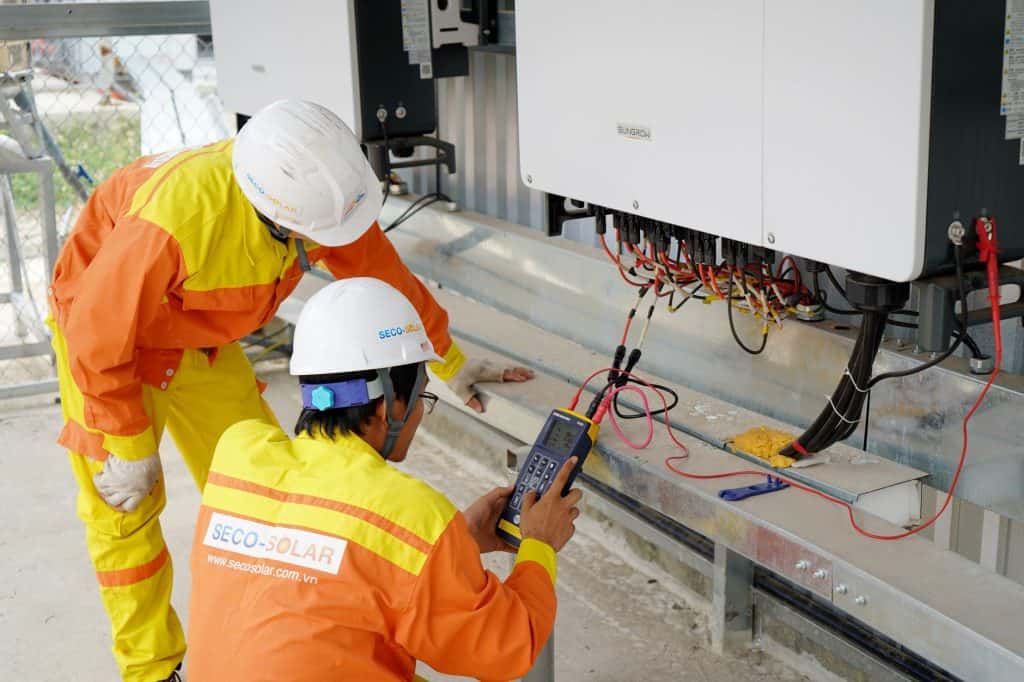
- Measurement capture. The technician runs a handheld I-V curve tracer across the string, sweeps an infrared thermography camera along the row, or performs an insulation resistance test. AR is the router for that measurement, not the measurement itself.
- Evidence attachment. Photos and instrument readings auto-bind to the asset ID rather than to a timestamped folder someone has to sort later.
- Work order closed on device. The record is written back to the CMMS before the technician leaves the row.
For the overlay to be worth wearing, it must carry six fields at minimum: module serial, string number, combiner box ID, last recorded power output, warranty expiry, and the most recent thermal anomaly flag. Anything less and the technician is still cross-referencing a spreadsheet.
The data plumbing is the quiet failure point. The AR layer is only as current as the asset register behind it. A register that was last reconciled two module replacements ago turns the overlay into a confident display of wrong information — which is worse than a paper list, because the technician trusts it. Shift-end handoff only works if captured evidence reconciles automatically into the maintenance record and feeds the next cleaning or repair cycle.
Where the workflow breaks in practice: gloves make capacitive touchscreens unresponsive, helmet mounting shifts the display out of the calibrated eye position, and a full-day visit outlasts most headset batteries unless hot-swappable spares are carried. None of these are exotic problems. All of them get discovered on site rather than in the procurement meeting, which is why a single-day pilot on the actual array beats any demonstration in a conference room.
How Robotic Cleaning and AI Fault Detection Feed the AR Layer
AR sits at the human-facing end of an automated stack. The data is generated elsewhere — by solar panel cleaning robots, drone imagery and inverter telemetry — and AR presents it at the panel where a decision gets made.
The AI fault signatures that map onto AR pins are specific:
- Hot spots from thermography, localised to a module or cell string.
- String underperformance derived from inverter MPPT channel data compared against neighbouring strings.
- Soiling ratio drift from production versus irradiance comparison — the signal that says cleaning is due rather than a fault exists.
- Cracked glass or cell damage detected from drone or robot-mounted imagery.
Robotic cleaning on utility-scale single-axis trackers typically uses water-fed brush units, autonomous or remote-operated, run at night or in low-irradiance windows. That timing avoids production loss during the pass and thermal shock to glass that has been sitting at 60 °C. Where water supply is the constraint, dry brush robotics substitutes, at some risk of surface abrasion if grit is present. The cleaning robot removes the soiling; it does not decide when to run — that decision comes from the soiling ratio signal, and it is verified by a technician whose AR overlay shows the before-and-after production delta for that string.
Soiling magnitude deserves an honest framing rather than a quoted number. A light dust film typically costs single-digit percentages of output. Heavy soiling in dry, dusty or agricultural environments exceeds that band substantially — but the actual figure depends on local deposition rate, module tilt, wind exposure and rainfall pattern. State the assumption, measure against irradiance over a season, and refuse any universal percentage.
Agrivoltaika changes the soiling profile. Pollen, dust from tilling, and irrigation spray that dries on glass create deposition patterns a bare utility site does not see, and the physical presence of crops under the array constrains when a robot can pass at all. If the garden concept sits alongside the array, cleaning frequency and access windows are negotiated with the growing calendar, not just the weather.
The loop closes like this: AI flags an anomaly → a cleaning robot or technician is dispatched → AR-guided verification confirms the fix → the result is written back to the model, which sharpens the next flag. Break any link and the obnovljiva energija asset drifts back to calendar-based guesswork.
Hardware That Works Outdoors: Headsets, Tablets and Handheld Scanners
Four hardware classes are realistic for a solar installation in 2026-2027, and none of them wins outright.
| Option | Registration method | Hands-free | Offline capability | Best-fit task |
|---|---|---|---|---|
| Ruggedised tablet AR | Marker or visual SLAM | No | Strong, large local cache | Inspection and evidence capture |
| Industrial optical see-through headset | Marker or RTK | Yes | Varies; check cache size | Two-handed work on tracker rows |
| Smartphone AR | Visual SLAM, phone-grade GNSS | No | Limited | Low-stakes orientation, small sites |
| Handheld scanner with AR overlay | Scanner-grade SLAM | No | Yes, survey-grade | As-built survey, not ongoing upkeep |
Illustration of selection logic, not a product ranking.
Selection reduces to questions a buyer can actually answer:
- Do technicians need both hands free on a tracker row? If yes, the tablet is out for that task.
- Is the site in a high-glare latitude where a 2,000-nit display will wash out? If yes, choose video see-through or a tablet in shade.
- Is there usable site Wi-Fi at the string, or must the device hold the asset register offline? Utility-scale sites frequently have no connectivity at the row, so offline-first is a pass/fail requirement, not a nice-to-have.
- Is the hardware rated for the dust, temperature and impact range on site? Ingress protection rating and operating temperature range are the practical filter — a unit rated to IP65 tolerates dust and water jets, while an unrated consumer device does not. Consumer AR hardware is not built for a gravel-and-dust solarna farma in August.
A Cost Sketch for AR-Assisted Maintenance on a 10 MW Array
The following is an illustration built from stated assumptions, not a quote. Assumptions: a 10 MW array, two field technicians, annual inspection cycles plus periodic cleaning visits, and an existing CMMS that already holds a partially reconciled asset register.
| Cost line | Basis | Notes |
|---|---|---|
| Hardware per technician | 2 seats | Industrial headset or rugged tablet; industrial units cost materially more than consumer equivalents |
| Software licence per seat | 2 seats, annual | Often bundled with a CMMS module; check whether the asset register is vendor-hosted |
| Registration setup | One-off | Site survey plus fiducial marker supply and mounting, or RTK base commissioning |
| CMMS integration | One-off plus maintenance | Bi-directional sync so evidence writes back to asset ID |
| Training | Hours per technician | Including re-registration procedure after module replacement |
Illustration only. Hardware and licence pricing in this segment moves quickly; re-quote before committing, and treat any figure as valid for 2026-2027 only.
The benefit side must be expressed as time and avoided truck rolls, never as a yield guarantee. The defensible claim is narrower: fewer repeat visits because the correct string was identified the first time, and shorter outage windows because diagnostic time on a large array collapsed. AR rarely pays back on inspection labour alone. It pays back when it prevents a second site visit — a full crew day plus travel — or when the array is large enough that an hour of avoided downtime across many strings compounds.
A simple breakeven test any operator can run: count the crew days lost last year to repeat visits for misidentified strings, multiply by loaded labour and travel cost per day, and compare that annual figure against the hardware, licence, integration and training totals above. If the avoided-visit sum does not exceed the annual cost within whatever horizon you set, delay the purchase and fix the asset register instead.
Any vendor quoting a specific percentage production uplift from AR alone should be asked for the measurement method, the control group, and whether the uplift was actually attributable to cleaning rather than the overlay.
Where Augmented Reality Solar Maintenance Fails — and What Kills the Programme
Failure modes here are specific, not generic.
- Stale asset data. If the overlay is not tied to a maintained register, it presents wrong serial numbers with full confidence. This is the most common programme killer and it has nothing to do with the hardware.
- Registration drift on single-axis trackers. The array moves. The overlay must anchor to tracker position and be re-registered after any module replacement or racking re-torque. Ask the vendor how the overlay behaves at stow position and after a module swap — before purchase.
- Outdoor optical limits. Sunlight washout and glare off glass are permanent conditions, not edge cases. AR also does not solve the reason the technician is standing in a field at 40 °C.
- Worker adoption. Gloves, helmets, safety glasses and lanyards all compete with head-mounted hardware. Kit that is unsafe or uncomfortable gets left in the truck, and the licence renews anyway.
- Record ownership. If the AR vendor owns the asset register, the operator is locked in. The register is the operator’s intellectual property and should be exportable in a documented schema.
And no AR layer substitutes for the underlying physical routine. Solar panel cleaning still has to happen at the right interval, on the right surface, without scratching glass or voiding a module warranty. Regular cleaning executed on a documented schedule beats a sophisticated overlay applied to a dirty array every time. Solarni paneli do not care how well the technician could see the fault if nobody washed them.
Deciding Whether Your Array Needs AR, Robotics, or Just a Cleaning Schedule
The threshold test comes first: below a certain array size and string count, a maintained paper or digital asset map plus a fixed cleaning schedule solves the same problem at a fraction of the cost.
| Array size | String complexity | Soiling severity | Asset data quality | Recommended first investment |
|---|---|---|---|---|
| Small rooftop | Single or few strings | Any | Any | Documented cleaning schedule and inspection log |
| Mid-size, uniform rows | Moderate | High, consistent | Adequate | Robotic cleaning before AR |
| Large, many strings and combiners | High, rotating technicians | Moderate | Trusted and maintained | AR for identification, integrated to CMMS |
| Large agrivoltaic | High | Variable, crop-driven | Needs dual overlay | Asset register rebuild first, then AR |
Illustration of decision logic, not a prescription.
The sequenced rule: robotic cleaning becomes defensible before AR when rows are large and uniform, single-axis trackers are in place, soiling is consistent, and a water source or dry-brush suitability exists. AR becomes defensible when string and combiner count is high, multiple technicians rotate through the site, downtime is genuinely expensive, and — critically — the operator already trusts the asset register. Where neither is justified, the answer is regular cleaning at a set interval with a documented inspection log.
Any regulatory or tariff driver for reducing downtime is time-sensitive and subject to change. Do not build the business case on a support scheme that may not exist in the next tariff period.
Agrivoltaics Complication: AR Where Crops Share the Array
A dual-use array changes the maintenance plan because crop rows, irrigation lines, seasonal tilling and harvest traffic all cross the same physical space the technician and any robotic cleaning unit must use.
The soiling profile shifts. Pollen during flowering, dust from tilling, and irrigation spray that dries on glass create deposition patterns and cleaning intervals a bare utility-scale site never sees. Agrivoltaika also imposes access windows: a cleaning pass that would compact soil or damage a standing crop has to move.
AR’s specific value here is a dual overlay — electrical layout and agronomic layout shown in the same spatial frame. A technician or robot operator can route around a crop row without commissioning a second site survey, and the string map stays legible against the planting map.
Robot access constraints are real: row spacing, ground clearance, turning radius and crop height all limit whether a cleaning robot designed for uniform tracker rows can operate at all. Many cannot, and the plan has to assume manual or semi-manual cleaning in those blocks. This is directly relevant to Solar Plus Garden’s direction, where the garden and community concept sits alongside the solar asset and both share ground. Published, hard operational data on AR in agrivoltaic settings is thin — treat any benchmark you are shown as a starting assumption to verify, not a specification.
Često postavljana pitanja
Do I need AR to identify which string is underperforming, or does monitoring already tell me?
Monitoring typically tells you which string or MPPT channel is underperforming. What it does not do is shorten the trip from the truck to that string. AR earns its place when on-site identification is the bottleneck — many strings, many combiners, technicians who do not know the layout by heart. If one technician knows the site and the array is small, a maintained asset map does the same job.
Can AR headsets replace solar panel cleaning robots on a large solar farm?
No — they solve different problems. Solar panel cleaning robots and AI anomaly detection produce the condition data and remove soiling; AR presents that data to a person at the panel. A cleaning robot on a tracker row and an AR-guided technician closing out the resulting fault are complementary steps in one maintenance loop, not alternatives.
Does the AR overlay still work on a single-axis tracker where the array has moved?
Only if registration is anchored to tracker position rather than a fixed site coordinate, and it must be redone after any module replacement or racking re-torque. This is the most common technical failure point. Ask how the overlay behaves at stow position and after a module swap before you sign.
How much production do I lose before regular cleaning becomes worth the cost?
Light dust films typically cost single-digit percentages of output; heavy soiling in dry, dusty or agricultural environments costs substantially more. The honest answer is that the threshold depends on local soiling rate, tariff and cleaning cost, and the correct method is to measure production against irradiance over a season rather than adopt a quoted number. Treat any specific figure offered for your site without measurement with suspicion.
Start by answering one question before buying anything: is your bottleneck identification or soiling? If it is soiling, a documented regular cleaning schedule — robotics where rows are uniform and soiling is consistent — comes first, and AR adds little. If it is identification on a large, string-heavy array, price AR as hardware per technician, licence per seat, registration setup, integration to your existing asset register and training hours, then check whether the avoided repeat truck rolls justify it. Your answer changes if the asset register cannot be trusted, if the site is agrivoltaic and needs a dual electrical and agronomic overlay, or if any downtime-related tariff or support scheme you are relying on is revised — those are subject to change and should not carry the business case on their own.